Whatever your reasons for wanting to learn pole: it isn't always the most accessible hobby. It can be hard to find good quality studios in some parts of the world and it can also be expensive.
Lucky for you it has never been easier to learn online at home! From a wide range of equipment to buy from or online learning platforms to access - you’ve got a lot of options.
In part one we are going to look at setting ourselves up for training at home: including buying a pole, crash mats and other equipment that can be useful.
It's important to consider that, although the upfront cost is a lot, a good quality pole and crash mat can last many years and will save you thousands in class fees. Some companies even offer payment plans to help spread the cost.
Buying a Home Pole
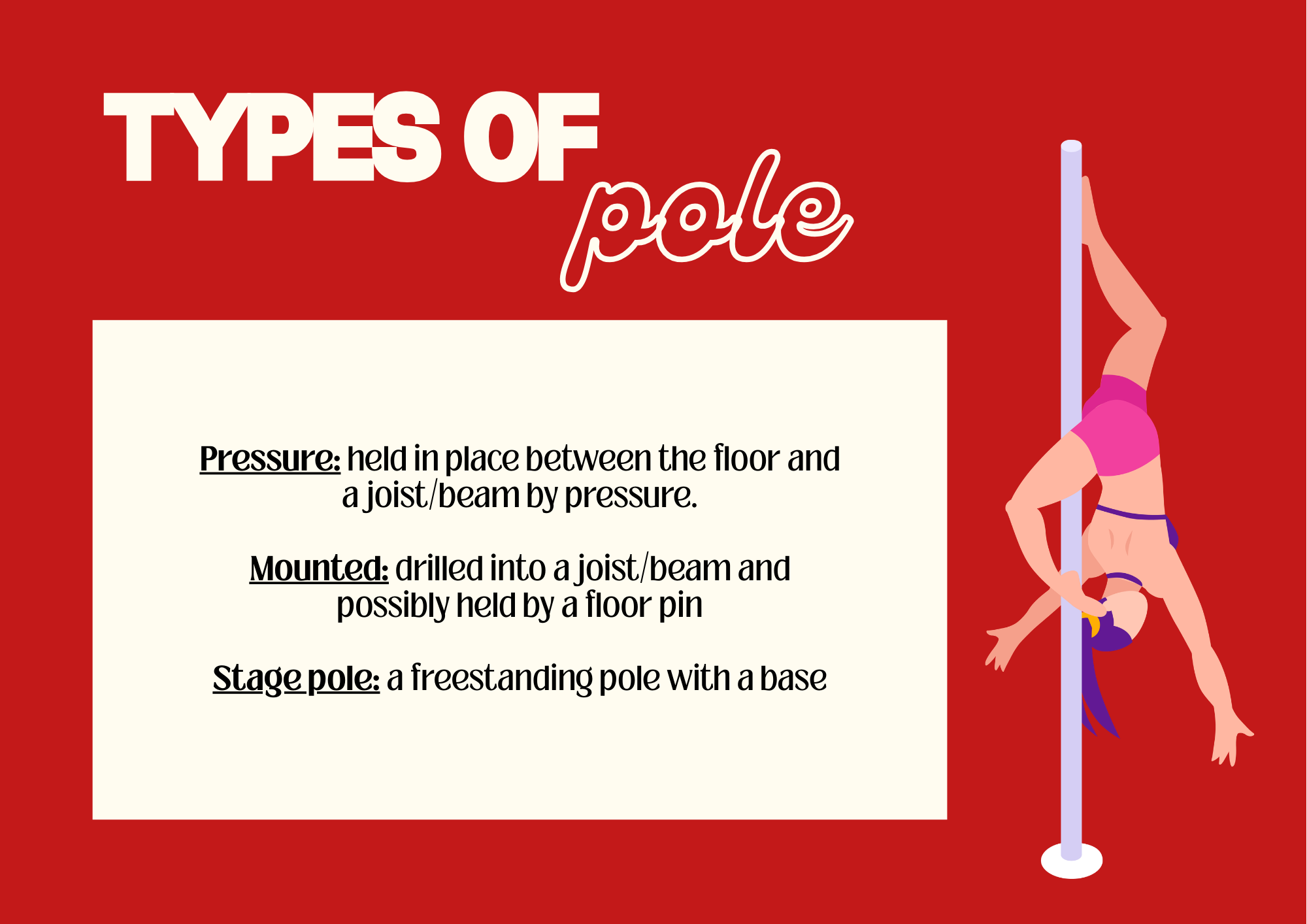
Pressure Poles
Pressure poles are held together in place by...pressure! The pole expands (lengthens) and wedges between a joist/beam and the floor.
Benefits:
- Do not need to be drilled into the ceiling
- Quick to install or remove
- Both height adjustable or custom one piece poles available
Negatives:
- Dangerous if not safely installed
- Not suitable for all ceilings
Segmented height adjustable poles are only recommended for less than 3 metres height. Then you'll need a one piece pole.
Mounted Poles
Mounted poles include a mount that you drill into your ceiling. There are options for different ceilings including wood, concrete, metal and even sloped ceilings. What you'll need will vary depending on your ceiling and the pole brand you choose to go with. You'll need to contact them for advice.
Benefits:
- Safer and more secure
- Pole can be permanent or removable
Negatives:
- The mount stays on the ceiling
- More expensive and not suitable if renting
The pole can either be fixed into the mount, so you'll need to remove the mount to remove the pole, or slot into the mount, meaning the mount stays fixed to the ceiling but the pole can be removed easily. You can get floor pins for some brands that fix the pole to the floor for extra safety.
These poles can come in segments, so you can easily change the height, or in one piece that is ordered to size. Segmented poles are only recommended for less than 3 metres height. Then you'll need a one piece pole.
Stage Poles
These are free standing poles that you can put up anywhere! They will come with a base, that helps to weigh the pole down, and do not need to be fixed to any ceiling or floor.
Benefits:
- Don’t need to worry if your ceiling is safe or not
- Can use almost anywhere
Negatives:
- Often heavy and harder to put together
- Often made for high ceilings so you may need to buy extra extensions for shorter ceilings
- The base of pole limits the ability to do floorwork
These can be heavy and laborious to put up and down, depending on the brand, but are great for outdoor pole-ing, events and for those with super high ceilings and plenty of floor space.
Stage poles do have more movement to them as they sway but are perfectly safe when used appropriately (you may not want to do big dramatic static movements or have more than one person on some of them).
Pole Diameter and Finish
To make it even more confusing there are also different pole diameters and finishes, plus some poles spin and some don't!
Pole Diameter:
40mm may suit someone with small hands but can make leg grips harder for some students.
45mm tends to be the most popular as it offers the best overall hand and leg grip.
50mm are rare these days but some old school pole dancers still might like them. These are much thicker and harder to hold with your hands but great for leg and body grip.
Finishes:
Chrome is a standard finish that is neither particularly grippy or slippery. This is the cheapest option for your home pole. However, chrome poles are usually plated and can start to wear away. If you have a nickel allergy this can become a problem as the pole ages.
Brass poles tend to be grippier in more humid climates but they do require more maintenance. Would avoid unless you live in a warm humid climate.
Stainless Steel is personally my favourite. They are longer lasting, as they are usually solid steel rather than coated, and require less maintenance. Some people do find them more slippery though.
Titanium is a pole finish I have absolutely no experience with and have no idea about unfortunately.
Powder Coated poles are coated in a plastic feeling material (think like the monkey bars at the park) and can be grippier than traditional metal poles. This is the same material used on aerial hoops. They can be much more grippy for individuals with dry skin in my experience but that also can mean they're more painful. Individuals who tend towards being sweatier or oiler may even find them less grippy. They come in fun colours!
Silicone poles are coated in a rubbery sticky silicone like sleeve. They provide insane grip and allow you to pole with your clothes on but do come with many downsides. They are more painful, your clothes can slip against the pole, I've been suffocated by my own jumper a few times, and it can limit the kinds of skills you can do.
They can be good for students with hyperhidrosis and I use mine for teaching in winter and for social media posts (so I can stay clothed and appease the social media gods).
Static vs. Spin:
I highly recommend that everyone has a pole that does both spin and static.
Static poles are simply, well, a static pole. They don't move so you have to create the movement.
Spin poles use bearings, kind of like the wheels on roller skates and skateboards, so that the pole itself rotates and creates the spin whilst you hold on.
Neither is better or worse or harder or easier. They're just different techniques. Some instructors to this day believe that static is better for beginners but the truth is that it really doesn't matter. You CAN learn to pole entirely on spin from day one safely: as myself and thousands of my students over the last decade can attest.
Most pole dancers do both. At competition level you usually have both a static and spin pole and are expected to use both equally so learning both does have its advantages. Even if you never want to compete you'll find that both styles of pole have something to offer.
Different Pole Brands
There are so many pole brands that have come and gone in my career. The only two I have had personal experience with are X-Pole and Lupit Pole. Both of these are the most popular brands in most countries and been around the longest. However, there are other options I have included below.
You'll need to do more research on these as I am unsure of safety, price and availability. It might be helpful to ask on social media (groups, reddit etc) what the most popular option in your country is.
- Lupit
- ThePole
- RPole
Avoid cheap poles. They rarely have any kind of available load testing documentation and use less safe technology. Poles that have sections that screw together are a particular risk. The metal is thinnest at the point where the two sections screw together and over time can weaken. I've seen these poles literally snap.
A brand new cheap pole may be safe for some time but I personally wouldn't risk your safety, pole is serious stuff, and would never ever buy one that was secondhand. You won't always know if a secondhand pole has been well maintained and is still safe to use.
Poles have an average lifespan of 2-5 years, depending on use, but if you buy quality and maintain your equipment it could go a decade or more.
Which to pick?
This is a hard question to answer because...it depends. On lots of factors. If you currently attend a studio then enquire into what poles they use so you can stick with what you're used to. Most students, and studios, tend to go with the X-Pole Xpert Chrome in 45mm so if you have no idea whatsoever this is a good place to start. It's affordable and suits most people.
Can I put a pole on carpet?
Yes you can but it can be limiting for some skills, particularly if you're more dancey, and you'll need to be extra careful with checking your pole. Carpet tends to compact over time which could lead to your pole loosening and falling down. There is a video on how to check your pole below.
How much space do I need for a pole?
It is generally recommended to have two metres around your pole in every direction but even a lot of studios do not have that so don’t stress too much.
One way to test your space is to put up your pole and hold it, or hold a broom where you’d like to put it, and walk around with your arms outstretched. If you don’t hit anything on the way around you have plenty of space. If you do you need to consider if you can work around the limitation or if you can put the pole somewhere more suitable or move furniture.
My home pole space only provides adequate space on one side and there is so much I can do. All of my tutorials are filmed in that space so if it’s on my platform you can probably do it in a small space.
Installing your Pole
It is important to fully read the manufacturers instructions and follow them exactly as every pole is different.
Most pressure poles are fairly easy to install, and most manufacturers will be happy to give you advice, but if you get stuck you could reach out to a rigger, pole specialist, builder or some other professional in your community for help. There are also lots of installation videos and guides online - just do a little search!
Pole Safety Checks
Below is a video showing how to do safety checks on a pressure mounted pole but the same is true of a mounted pole also. Every time you use your pole, and regularly throughout training, you should be doing safety checks on your pole.
You should also be checking over the components on stage poles and mounts and ensuring everything fits together nicely, there are no loose bolts, no weird sounds or movement and that the pole is safely attached to the base.
Safety Equipment
Pole is, in my opinion, an extreme sport as well as a dance form. This means it could be high risk if we are not putting in place safety precautions. We'll talk more about safe training in Part Two but until then... here are a couple of things you may want to buy.
Crash Mats
Buy the thickest biggest pole crash mat you can. Falling, even from a low height, can be life changing. You can absolutely pole at home safely but the worst injuries I have heard of have been within the home environment and a number of people have ended up paralysed temporarily or permanently. Your safety is no joke! You can still hurt yourself falling onto a mat (we will talk about safe falling practices later) but it is significantly reduced when paired with other safety practices.
I like foam4sports but many pole brands sell crash mats. Ensure you buy mats specifically designed for pole dancing.
Knee Pads
We do a lot of floorwork in pole which requires us to put a lot of pressure into our knees. Some instructors claim your knees will toughen up but it's not true. Prolonged kneeling and rolling over the knee cap, often over years, can lead to degeneration of cartilage or other issues such as bursitis. Joints do not "toughen up" and you don't want to end up having knee replacement surgery later in life.
You only get one set of knees!
Soft thick volleyball knee pads are ideal but many brands sell pole knee pads now as well that have more space in the back for knee hooks and have sticky grippy sections to make various tricks easier.
Learn to Pole Dance at Home Part 2: Starting Your Journey
You can sign up now to access a 6 week beginner course plus over 700 tutorials and classes consisting of everything you need on your journey.